


The resilience of destinations and infrastructure, the extension of the tourism season, overtourism, and short-term rentals were among the topics discussed on the first day of the “Reimagine Tourism in Greece” conference by Kathimerini.
In the new Doctrine and the possibilities for further development of Greek tourism referred the president of SETE, Giannis Paraschis, spoke at the closing of the third annual “Reimagine Tourism” conference by Kathimerini, which took place on Tuesday, 18 and Wednesday, 19 November 2025 in Athens.
As Mr Paraschis emphasised, the years 2023, ‘24, and ‘25 were the best in the history of Greek tourism, which withstood the test of coronavirus, strengthened its brand and attractiveness, resulting in becoming a pillar of the Greek economy.
We need a ten-year master plan, he added, with very important interventions in both private and public investments, based on four pillars: operational regulations, the application of technology and Artificial Intelligence, infrastructure with clearly defined responsibilities of the state and Local Government, and spatial planning.
A. Andreadis: Authentic hospitality as Greece’s exportable product
The need for long-term economic planning was underlined by Andreas Andreadis, CEO and co-Managing Partner of the Sani/Ikos Group, during the discussion titled “When Greek tourism exports know-how”.
Mr. Andreadis referred to the Greek product he considers exportable: authentic hospitality. As he said, the Greek human capital possesses a natural inclination toward offering services with warmth and immediacy.
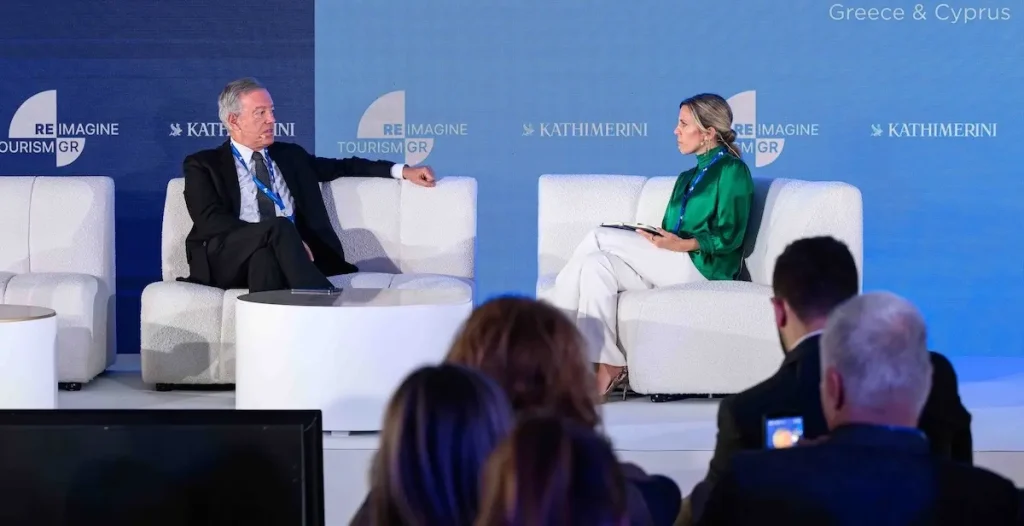
Kathimerini Reimagine Tourism in Greece
“The DNA of the Greek, the willingness to provide services truly from the heart, is an advantage we have not leveraged as much as we should,” he noted. He even estimated that the percentage of people who possess these characteristics is three times higher compared to Spain (15% versus 5%), a factor that, as he said, can become a lever for growth, provided it is properly supported with training and clear structures.
Infrastructure and yachting
Representatives of the sector referred to the new era and regulatory framework for yachting and marine tourism in Greece. Michalis Chrysikopoulos, Global Managing Partner at IYC, emphasized that Greece now holds the global lead in chartering vessels over 24 meters and pointed out that significant focus should be placed on improving infrastructure and the services provided, but even more on mooring prices and VAT.
Emilios Melis, Head of Strategy Services at PWC, highlighted the importance of having regulations concerning yachting in Greece. As he noted, beyond VAT regulation, it is important to designate anchorages, as this will also combat the widespread illegality in the sector.
Pressures on Symi from tourism
The Mayor of Symi, Eleftherios Papakalodoukas, spoke about the enormous effort made to turn Symi into a global destination and the largest anchorage in Greece. However, he pointed out the significant problems caused to the island by the overwhelming number of arrivals, forcing the Municipality to deploy its entire staff for cleanliness and other services. He stressed the importance of introducing a 3-euro fee, as he has proposed—and as other islands, including some in the Cyclades, have supported—so that Symi can generate revenue to cover the needs of the millions of visitors it receives.
The National Archaeological Museum
The future of the country’s most important cultural institution and its transformation into a global destination that will redefine the area of central Athens was at the core of the panel “Can the New Archaeological Museum Become a Global Tourism Destination?”. “If the museum in Cairo is called the ‘Museum of Museums,’ ours is the ‘Museum of Museums of Western Civilization’,” stated Architecture Professor Andreas Kourkoulas, capturing the significance of the project.
The Chair of the Board of Directors of the National Archaeological Museum, Ioanna Dretta, provided, for the first time with such clarity, a rough timeline for the project’s implementation: The studies are expected to be completed by mid-2027. Immediately afterward, the tendering of the project and the transfer of exhibits will begin, as the museum will need to close to the public. The nominal construction period is estimated at four years, while at least another year will be required for the installation of the exhibition. In its new form, the museum will display approximately 16,500 objects, many of which will be shown for the first time, covering 10,000 years of culture. “The major challenge is for the new museum to become a focal point for the area and achieve a balance with the local community,” said Mr Kourkoulas, emphasising that, unlike the Acropolis Museum, which is a global landmark, the National Archaeological Museum must win over the residents of Athens. The discussion closed with a shared understanding that the New National Archaeological Museum is not designed merely for today but as a landmark that will serve culture for the next two centuries.
The primary sector and one-sided tourism development
In the panel “Tourism and Local Production,” chef Lefteris Lazarou stated, “The primary sector of Athens, of Attica, has been lost. The large fields in Renti have become agencies. A heavy tourism industry cannot exist without spaces for people to cultivate.”
Katerina Moschou, founder of the dairy “To Parion” in Paros, spoke about the reactions of the local community on her highly touristic home island, which was surprised by the establishment of such a production unit instead of yet another tourism business. “Tourism grows on the island in a one-sided way. There are no limits, no respect, no balance,” she said, adding: “We face the challenges of insularity, and there should be safety nets for those of us who still have the passion and romanticism to engage in production, because we safeguard traditions and local culture and offer raw materials that elevate our region’s gastronomy.”
Closing the conference, the Director of Kathimerini, Alexis Papachelas, stated that at the start of the “Reimagine Tourism in Greece” initiative there was suspicion regarding the direction of the conversation. Three years later, “we’ve reached a point where everyone agrees, and we now mainly face the politicians and the state, from whom we ask for more action.” He added that what the country needs are ministers who make decisions without calculating political cost, and noted, “We want to be practical and always promote solutions, trying to help move this effort forward.”





