


“We are talking about quality upgrading, but almost 85% of hotels cannot be financed,” emphasized the president of the Panhellenic Hoteliers’ Federation (PHO), Yannis Hatzis, in his speech at the 13th General Assembly of the PHO.
“How can there be an upgrade in quality when access to capital is the exception and the cost of digital and environmental compliance suffocates entrepreneurs?”, he wondered.
Small and very small hotel businesses, with their constant effort over decades, have brought us to where we are today, “they created and internationally highlighted the concept of Greek hospitality,” he stated.
However, as he noted, this operating model is not always in line with the way financial institutions finance.
At the same time, Mr. Hatzis said that the sector is our national shield.
However, he spoke of a “substantial lack of institutional attention” in the hotel sector. “We should not accept any discussion about production models where tourism is not a central pillar of the economy,” he stressed.
The president of POX stated characteristically: “It is time for [society and the political world] to stop looking for “fat cows for milking” and “hens with golden eggs” and to support real investments that create substantial regional added value.”
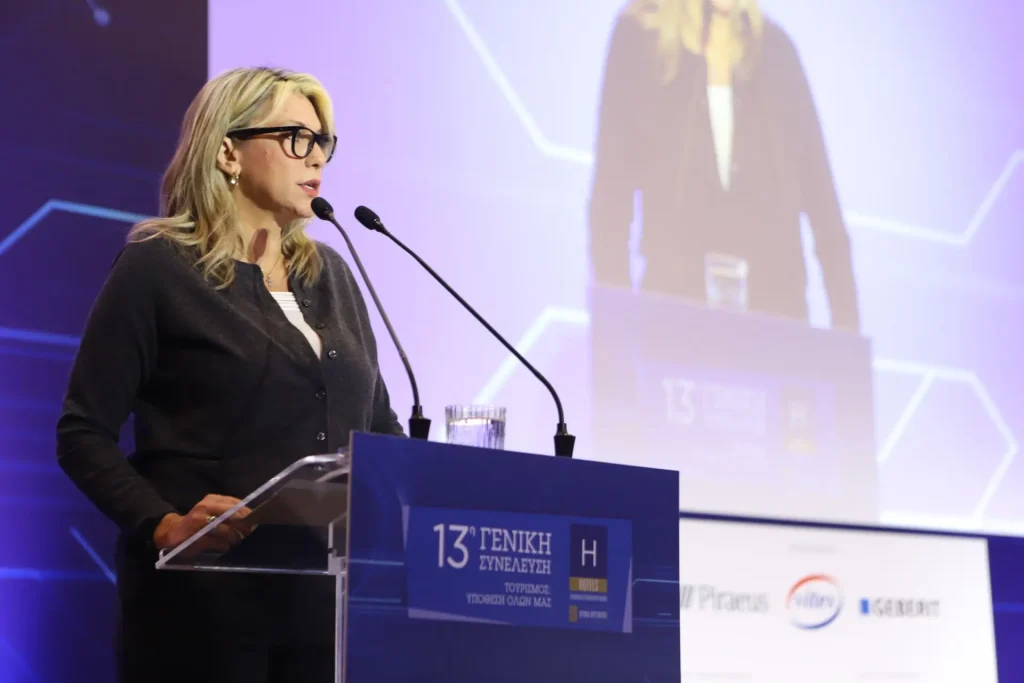
A. Karamanli: The hotel sector is the wind in the wings of Greek tourism
Tourism is a strategic pillar of the country’s development that promotes extroversion and creates opportunities, and on this path the hotel sector is the wind in the wings of Greek tourism, stated the Deputy Minister of Tourism, Anna Karamanli, from the podium of the General Assembly of the Hellenic Tourism Association.
The Deputy Minister referred to the enhanced performance of Greek tourism, with revenues exceeding 20 billion euros in the first 9 months of 2025, which demonstrates the resilience of the tourism sector in an environment of competition and crises, as well as the positive indications for 2026 from the WTM exhibition in London.
However, “a major challenge is to ensure that development is socially just, environmentally responsible and economically sustainable,” stressed Ms. Karamanli and reiterated that sustainability is not an option but a necessity.
The Deputy Minister emphasized the decisive contribution of the new special spatial planning framework for tourism, which sets rules and priorities that govern the development of Greek tourism in terms of sustainability and competitiveness. The government’s will, she said, is to proceed with the spatial planning after the completion of the consultation. The appropriate impact assessment study by the Ministry of Environment and Energy is now expected, which was put out for public consultation.
Read also
Al. Vassilikos | The 5 axes for the “next day” of Greek Hospitality





