


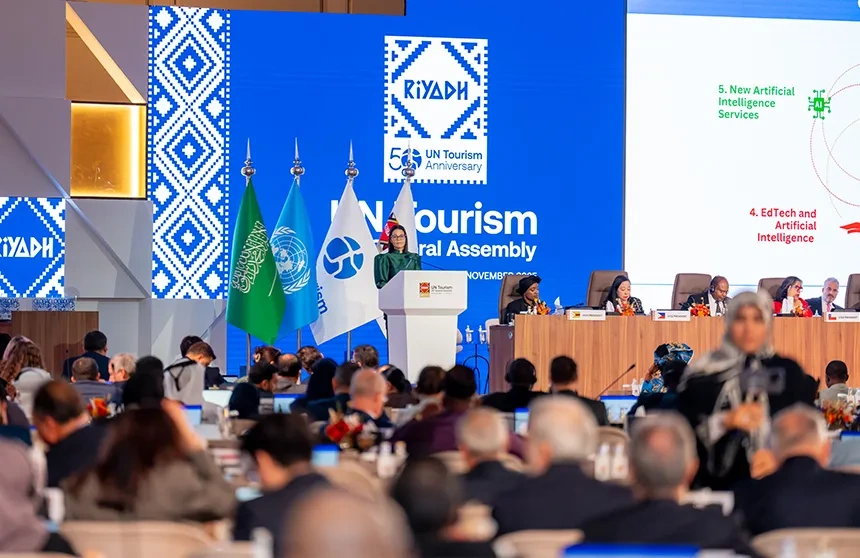
The World Tourism Organization (UN Tourism) concluded its largest ever General Assembly in Riyadh, presenting a new global roadmap for integrating Artificial Intelligence (AI) across the travel and tourism sector. The meeting coincided with the 50th anniversary of the Organization’s founding and brought together representatives from 148 Member States, including 90 Tourism Ministers and 70 Ambassadors, in a historic session that marked the industry’s transition to a digital and technology-led era.
The “Riyadh Declaration” on the Future of Tourism
A key outcome of the three-day General Assembly was the adoption of the “Riyadh Declaration on the Future of Tourism”, which makes artificial intelligence and digital innovation key pillars for the growth and resilience of global tourism.
The Declaration calls on Member States to strengthen international cooperation, invest in digital infrastructure and harness new technologies to empower local communities and small tourism entrepreneurs.
Artificial Intelligence in the spotlight
Reflecting the new strategic direction, UN Tourism dedicated a special thematic session to the relationship between Artificial Intelligence and tourism, bringing together government representatives, technology companies and international organizations.
The discussion focused on how AI can transform travel management, sustainability and workforce training.
Natalia Bayona, Executive Director of UN Tourism, presented the Organization’s priorities in the field of AI and stressed the need for coordinated policies between States.
More than 30 heads of delegations participated in the policy discussion, including Apostolos Tzitzikostas, EU Commissioner for Sustainable Transport and Tourism, as well as representatives from Amadeus, Trip.com, Microsoft and the World Economic Forum.
Innovation Awards and the role of startups
The UN Tourism Artificial Intelligence Challenge finals were also held during the Assembly, highlighting the most innovative tourism applications of artificial intelligence.
“Smart Tour” from Brazil was the big winner, for its pioneering use of AI to improve the visitor experience and promote sustainable travel practices.
New leadership and global expansion
Member States confirmed the election of Shaikha Al Nowais as the next Secretary-General of the Organization, who will take office in 2026. She is the first woman to lead the specialized UN agency for tourism — a decision with strong symbolism for inclusivity and diversity in the sector.
At the same time, the UN Tourism Africa & Americas Conference was approved as a permanent biennial meeting, as well as the creation of a South-South Cooperation Mechanism to exchange expertise and technical support among developing countries.
At a strategic level, UN Tourism accepted China’s proposal to establish a Regional Office in Shanghai, which will serve as a hub for innovation, investment and regional cooperation.
Upcoming global actions
The participating countries also approved the next thematic cycles and organizers of World Tourism Day:
El Salvador will host the event on “Digital Agenda and Artificial Intelligence” in 2026,
while Cape Verde will host the event on “Transforming Tourism through Education” in 2027.
In addition, the Dominican Republic was chosen to host the 27th UN Tourism General Assembly, confirming the region’s growing role on the global tourism scene.
Digital Transformation and Sustainable Development
UN Tourism Secretary-General Zurab Pololikashvili stressed that Artificial Intelligence will be a catalyst for the next five decades of global tourism:
“The tourism of the future will be transformed through innovation and Artificial Intelligence. UN Tourism will continue to guide Member States to fully harness the power of technology to transform the sector and create opportunities for all,” he noted.
The Riyadh General Assembly concluded with a clear message: tourism is entering a new digital era, where collaboration, innovation and technology will be the foundations for a smarter, more resilient and inclusive sector.





