


Exhibitions that inspire travel to London, New York, Tokyo, Paris, Madrid and what is coming to Greece
2026 is shaping up to be a major year for art travellers: leading capitals are unveiling exhibitions that reintroduce classic names through fresh perspectives, while at the same time giving space to women artists, political narratives, and large-scale retrospectives that function as true cultural events. For anyone planning trips around art, 2026 offers a rare opportunity to see the international scene simultaneously engaging with light and darkness, with painting itself, and with the ways our era is rewriting how we see.

London: The greats of British art and a year full of blockbusters
London is playing strong cards with crowd-pulling names: Tracey Emin at Tate Modern (27 February31 August), Lucian Freud: Drawings at the National Portrait Gallery (12 February3 May), David Hockney at the Serpentine (12 March23 August), and Barbara Hepworth at the Courtauld (12 June6 September). Tate Britain continues with Whistler (21 May27 September) and later the dual exhibition Vanessa Bell & Duncan Grant (12 November11 April 2027).
At the same time, the Barbican opens a major Pan-Africanism axis with Project a Black Planet (11 June6 September), Tate Modern hosts Frida Kahlo (25 June3 January 2027), the National Portrait Gallery honors Marilyn Monroe (4 June6 September), and Tate Britain dives into pop culture with The 90s (1 October14 February 2027).
Finally, the National Gallery is preparing a major monographic exhibition on Francisco de Zurbar?n (2 May23 August), featuring around 50 works traveling from Madrid, Paris, and Chicago.

Paris: Sensory experiences and major retrospectives
Paris opens the year with a dialogue around light: the exhibition Georges de la Tour at the Mus?e Jacquemart-Andr? (until 25 January) brings back the magician of candlelight and the intensity of dark illumination as pure narrative.
Immediately after, the group exhibition Clair-obscur at the Bourse de Commerce (4 March31 August) takes up the legacy of chiaroscuro and carries it into contemporary practice not as a technical trick, but as a language.
In the same city, 2026 also appeals to the senses: at the Mus?e de la Musique, Kandinsky: The Music of Colour (until 1 February) explores Kandinskys synesthesia, with nearly 200 works and an emphasis on the relationship between color and sound.
For lovers of major retrospectives, the Mus?e dOrsay presents Renoir and Love (17 March19 July), featuring works brought together in rare reunions, while the Mus?e de lOrangerie hosts Henri Rousseau: The Ambition of Painting (25 March20 July), giving Rousseau the full weight of a major retrospective.
And for one of the most eagerly anticipated returns to creative resilience, the Grand Palais (in collaboration with the Centre Pompidou) presents late Matisse (24 March26 July), focusing on the years 19411954 and the famous cut-outs.
Bonus highlights from the early months: the Mus?e dArt Moderne de la Ville de Paris presents two standout exhibitions, George Condo (until 8 February) and Otobong Nkanga (until 22 February).

New York: Fresh eyes on familiar names Schiele, Gainsborough, Klee, Hujar
New York builds 2026 around a very specific promise: to reveal unfamiliar sides of artists we thought we knew. At the Neue Galerie, Egon Schiele: Portrait of Dr. Erwin von Graff (12 February4 May) focuses on a defining relationship between Schiele and a Viennese gynecologist, casting new light on the body and the sensitivity of his gaze.
At the Frick, Gainsborough: The Fashion of Portraiture (12 February11 May) looks at portraiture through a fashion lens a clever perspective on how painting invents social image. And at the Jewish Museum, Paul Klee: Other Possible Worlds (20 March26 July) brings forward Klees later, lesser-known period in exile, when the Nazis labeled him degenerate.
Finally, for those who love photography as process, the Morgan Library and Museum presents Hujar: Contact (22 May25 October), with more than 110 contact sheets from his archive a rare backstage view of his visual thinking.

Tokyo: Postwar female avant-garde
Tokyo makes a strong statement with women artists and historical re-readings. The exhibition Anti-Action: Artist-Womens Challenges and Responses in Postwar Japan (until 8 February) at the National Museum of Modern Art examines 14 women artists from the 1950s60s (including Yayoi Kusama), giving context to practices that often remained in the shadows.
The Tokyo Metropolitan Art Museum celebrates its 100th anniversary with Edo in Focus (25 July18 October), drawing on works from the British Museum collection: screens, scrolls, and woodblock prints.
And for those seeking 90s energy, the National Arts Center, Tokyo presents YBA & Beyond: British Art in the 90s from the Tate Collection (11 February11 May), while the Mori Art Museum devotes a major exhibition to Mariko Mori (31 October 202628 March 2027), linking science, metaphysics, and Buddhist inspiration.
Madrid: A city that champions painting and the women who overturn it
Madrid places painting at the center of the year as a field of ideas. The Prado continues with Anton Raphael Mengs (until 1 March), while CaixaForum hosts Henri Matisse (until 22 February). In spring, the Thyssen presents Spains first retrospective of Vilhelm Hammersh?i (17 February31 May), while Fundaci?n Mapfre brings Anders Zorn (19 February17 May).
At the same time, women artists move to the foreground: Reina Sof?a with Maruja Mallo (until 16 March) and Aur?lia Mu?oz (29 April7 September), while in summer the Thyssen features the subversive narratives of Ewa Juszkiewicz (26 May6 September) and the landscapes of Carmen Laff?n (23 June27 September). In the background, the exhibition Inquietude: Liberty and Democracy (until 8 March) marks 50 years since Francos death, opening political dialogue through art.
The European grand tour of 2026: Basel, Amsterdam, Florence, Milan, Berlin, Venice
Beyond the major capitals, 2026 sets up an ideal travel route: in Basel, C?zanne with an emphasis on the late period (Fondation Beyeler, 25 January25 May). In Amsterdam, an exhibition on Van Goghs yellow (13 February17 May). In Florence, a major Rothko retrospective at Palazzo Strozzi (14 March23 August). In Milan, a monumental Kiefer installation (7 FebruarySeptember). In Berlin, Brancusi (20 March9 August) and Abramovi? (5 April23 August). And, of course, the Venice Biennale (9 May22 November), its 61st edition, with Greece represented by Andreas Angelidakis.
Greece: A year of landmark exhibitions and institutional relaunches
The Greek scene has its own major dates, combining international names, archaeological significance, and contemporary edge. The National Gallery expects the completion and reopening of its third floor (20th21st century rehang) in the first half of the year, along with a new temporary exhibition in spring featuring works and archives from the Kostakis Collection (MOMus).
At the National Archaeological Museum, the exhibition The Princes of Pylos (1 March30 June) brings into focus the striking finds of the Griffin Warrior and the Mycenaean world of Messenia.
The Museum of Cycladic Art welcomes Jeff Koons Venus (19 March31 August) in dialogue with prehistoric Venuses, while at the Stavros Niarchos Foundation Cultural Center, Barbara Kruger presents her first solo exhibition in Greece, featuring new works for the outdoor space (from April).

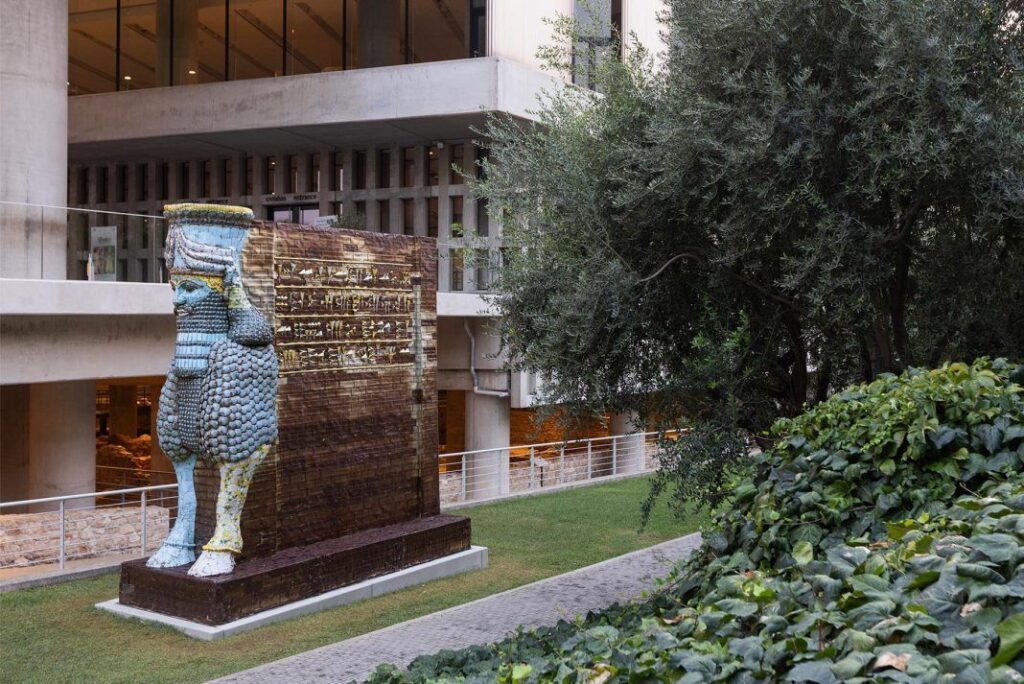
The Thessaloniki Biennale (MayJuly) promises expansion into new sites, including the Kalochori lagoon, while the Acropolis Museum presents the second part of the trilogy Michael Rakowitz and Ancient Civilizations (MayDecember).
Finally, the Benaki Museum dedicates an exhibition to the 200th anniversary of the Exodus of Messolonghi (18 February3 May), the Gennadius Library celebrates 100 years with 100 Objects (AprilJuly), and at the Xenokration in Messolonghi comes the core of a rare encounter: Delacroix and Greece on the Ruins of Missolonghi as the centerpiece of an anniversary exhibition (MarchNovember).





