


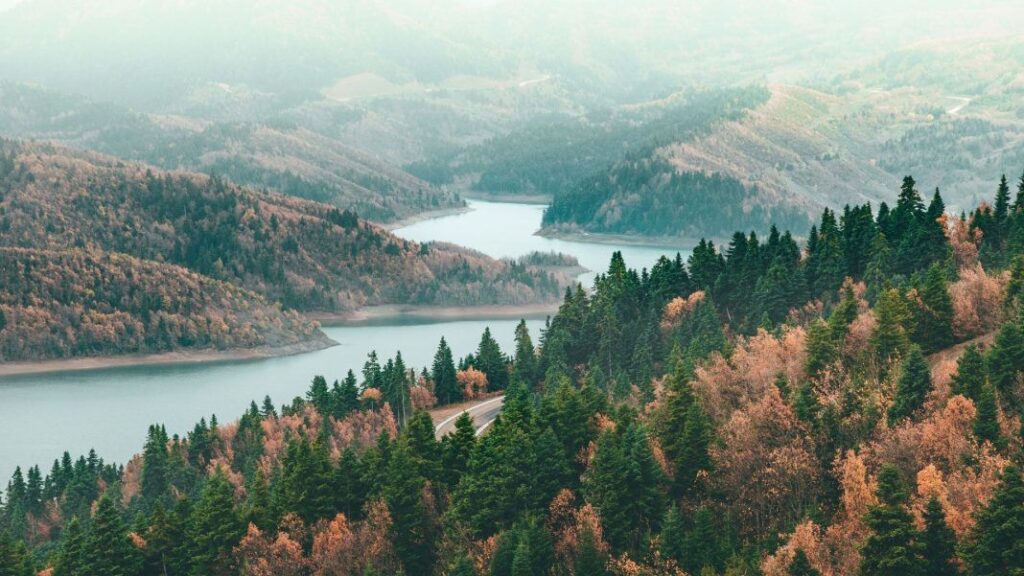
January is the month when Lake Plastira reveals its truest nature. When the festive bustle fades and tourists return to the cities, the landscape regains its calm. Mist embraces the deep-green fir trees with an almost metaphysical stillness, the peaks of the Agrafa Mountains hide behind a white mantle of snow, and the waters of the artificial lake mirror a sky that changes color every hour of the day.
This artificial lake, covering 24 square kilometers, was created in 1959 by the dam on the Tavropos River, also known as Megdovas. It lies just 35 kilometers from Karditsa, 314 from Athens, and approximately 240 from Thessaloniki. The winding road leading to its shores is part of the experience: the scenery changes at every turn, the temperature drops as you gain altitude, and the sense of distance from the urban rhythm becomes almost tangible.
The villages scattered around the lake live in a time that does not obey modern clocks. Neochori, Kryoneri, Kerasea, Pezoula, Neraida, Belokomitis, Kastania. Each name carries a story, each village has its own character. January here does not mean holidays and fireworks, but a return to rhythms that have almost been forgotten. Guesthouses with lit fireplaces become stages for local stories and legends, hospitality remains unpretentious, and evenings unfold with local tsipouro and wine from the vineyards of Mesenikolas.

Villages with character
Neochori, built amphitheatrically at 950 meters, is the most developed point around the lake. It offers panoramic views of the water and is a smart choice for those who want to combine comfort with nature. Slightly lower, Kalyvia Pezoulas stretches almost to the shoreline, ideal for walks along the icy water and for those who want to try activities such as canoe-kayak or archery, even in winter.
Kryoneri, at 850 meters, lives up to its name every January morning. Sparsely populated, it borders a dense fir forest that in winter becomes a fairytale setting. Higher up, at 950 meters, Kerasea stands amphitheatrically and is among the most picturesque villages in the area. Neraida, even higher at 1,120 meters, is literally buried among fir trees. The lack of tourist development here is not a drawback; it is what gives the village its special charm.
For those seeking near isolation, Belokomitis, at 930 meters, is the answer. It does not offer the impressive views of Neochori nor many accommodation options, but it is immersed in greenery and silence. Here, January feels like meditation.
On the opposite side of the lake, Mesenikolas overlooks the Thessalian plain and distant ridgelines. It is known for its red wine, Mavro Mesenikola, and its strong tsipouro. The small Wine and Vine Museum is worth a visit, as is nearby Morphovouni, the birthplace of Nikolaos Plastiras. This well-kept village turns its back on the lake and faces the plain. At the Nikolaos Plastiras Center for Historical Studies, visitors can explore the life of the statesman through rich archival material.
Paths and monasteries
January walks around Lake Plastira are mainly immersed in nature. Trails among fir trees, the lakes shores, village alleys, small chapels, and monasteries standing like guardians of history. The Monastery of Panagia Pelekiti is perhaps the most impressive. A post-Byzantine structure perched on a steep rock near the village of Karitsa, at an altitude of about 1,400 meters.
Its name comes from the rock on which it is built; according to tradition, craftsmen carved it with wooden tools following the Virgin Marys guidance. It was probably founded in the late 15th century by the monk Porphyrios and completed in 1529 by the neo-martyr Damian. The view from there is breathtaking, especially in January when everything around is dressed in white.
On the opposite side of the lake, in a lush green setting at about 800 meters altitude, stands the Monastery of Koroni. Its history begins as early as 1123, when an icon of the Virgin Mary was found, with Emperor John II Komnenos as its founder. It takes its name from the location that crowns, like a crown, the Thessalian plain. Built on the ruins of an ancient Greek temple, it was destroyed in the 16th century and rebuilt. The iconostasis from that period survives and is remarkably beautiful.

On the winter trails
The areas nature is crisscrossed with trails of varying difficulty. On the eastern side, the gentle hikes Morphovouni Agios Georgios Springs (2.2 km) and Morphovouni Gazi Peak mountain pass Mesenikolas (4.3 km) are accessible even to inexperienced hikers. On the western side, Gavel Fylakti is more demanding, while the routes Belokomitis Karagianni ridge Agia Paraskevi Koulia Agrafa Mountain Shelter and Kalyvia Neraida offer authentic winter experiences.
January at Lake Plastira is not a month for those seeking action and entertainment. It is a month for those who want to reconnect with rhythms that modern life has made us forget. It is for those who understand that sometimes the most valuable travel experience is not the one that fills an Instagram feed, but the one that fulfills the need for silence, greenery, and authenticity.
Dimitris Stathopoulos





